Fire door regulations
Fire Door Installation Cost
A certified fire door installation is usually priced per doorset, covering the door, frame, seals and ironmongery fitted as a complete assembly, plus labour. As a broad guide, a supplied-and-fitted FD30 doorset for a standard opening runs into the mid-hundreds of pounds, with FD60 and bespoke or heritage doors costing more. The rating, the door count and the condition of the existing opening move the figure more than anything else.
By Lee, Director · 20 August 2026 · 6 min read
What you are paying for
A certified fire doorset is tested and rated as a complete system: leaf, frame, intumescent and smoke seals, hinges and closer, all together. You are not buying a door leaf and fitting it into whatever frame is already there. That is why a genuine fire door installation costs more than hanging an ordinary internal door, and why a price that looks too good to be true usually means corners are being cut on certification or components.
The price of a supplied-and-fitted doorset therefore bundles the certified components, delivery, the labour to fit it correctly to the manufacturer's installation guidance, and the handover documentation that proves the whole set carries its rating.
FD30 vs FD60: why the price differs
An FD30 doorset resists fire for 30 minutes; an FD60 for 60 minutes. FD60 doorsets use denser, heavier cores and more robust hardware, so they cost more to supply and take a little longer to hang. But specifying FD60 where the building only needs FD30 adds cost without adding real protection, because the surrounding construction is only ever as strong as its weakest point. The right rating is set by your building's fire strategy, not by preference or by what is in stock. We advise on the correct rating so you neither under-specify nor overpay.
FD30 doorset
Most common in flats, HMOs and general commercial openings. Lower supply cost than FD60.
FD60 doorset
Used where the fire strategy demands it, such as certain high-rise and higher-risk locations. Heavier, dearer, slower to fit.
What moves the installation price
- Rating. FD60 costs more than FD30 to supply and fit.
- Door count. A block of identical doorsets is cheaper per door than a one-off replacement.
- The existing opening. A frame that is out of square, or a structural opening that needs making good, adds labour before the new set goes in.
- Bespoke and heritage work. Non-standard sizes, vision panels, or doors that must match a listed or period setting cost more than a standard doorset. This matters in places like Oxford and central London.
- Ironmongery. Certified closers, hinges, letterplates and locks are part of the rated set, and better specifications cost more.
- Access and hours. Out-of-hours or phased installation to keep a building running adds to labour.
Does the cost change by area?
The doorset itself costs much the same wherever your building is. What varies by area is travel and the type of building stock. In Northampton, our home patch, we hold the shortest lead times and lowest travel overhead, which keeps installation costs keen. In Oxford and central London, more of the work involves listed, period or higher-risk buildings, where bespoke doorsets and careful making-good push the figure up. If you want a realistic number for your building, the quickest route is to tell us the door count, the rating and the location, and we will price it properly.
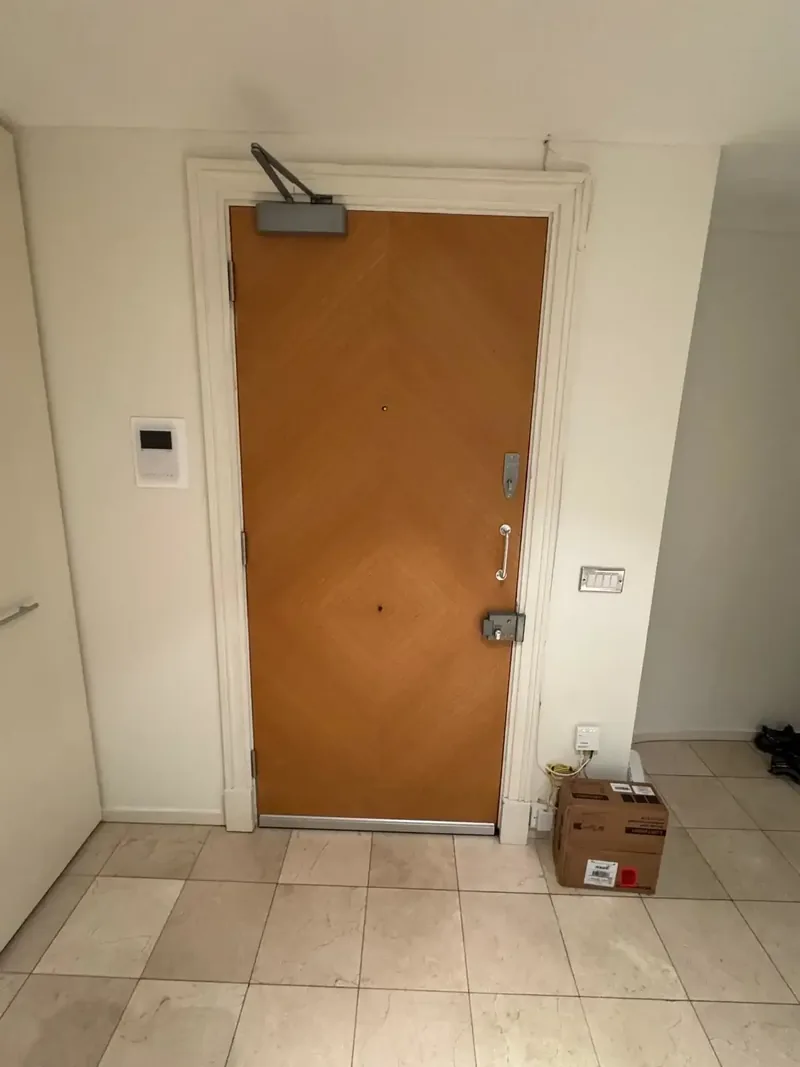
Photographed below: a completed fire door installation with an overhead self-closer, carried out on a live site.
Free guide, no email required
Installation and Remediation of Fire Doors
What BS 8214:2026 requires, and how to tell whether an installation has been done correctly. The same guide applies whichever part of the country your building is in.